Showing posts with label Picture Books. Show all posts

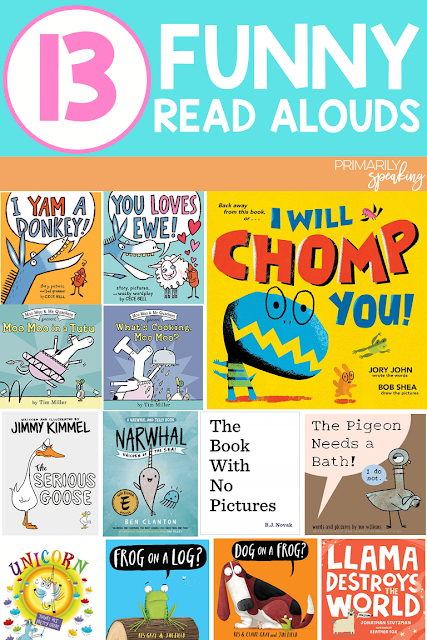
13 Funny Read Alouds

I think most teachers would agree that read aloud time is a magical time. Books that are read aloud can be used to work on listening comprehension, engage reluctant or struggling readers, facilitate discussion about sensitive and/or important topics, introduce new content, and to promote a love of reading. This post will focus on one of my favorite types of read alouds...funny (silly) picture books.

silly picture books

This post contains affiliate links for your shopping convenience. I earn a small commission each time someone makes a purchase through one of my links. For more information about my Disclosure Policy, please visit this link.

Often times read alouds are purposeful. We're told to choose books with intent and that serve a purpose tied to the curriculum. I definitely do this. Often. BUT, sometimes, I just read with the purpose of sharing a fun book. A story that is read and simply enjoyed. It isn't discussed in detail, I don't model any thinking as I read, I simply read and we all enjoy a great book. So, what's the purpose? To promote a love of reading. And, if you ask me, that counts as a purposeful read aloud.

What follows is a list of some of my favorite silly read alouds. I say some because I'm pretty sure I've left some titles off the list. So, don't be surprised if a part 2 to this blog post gets published soon. ;)

Again, these are books that I typically share with no other purpose than to promote a love of books, but it's OK if you use them to talk about other things, or to practice important comprehension skills, because many of them can be used to do just that!


The Serious Goose is about, you guess it, a goose that is very serious. The reader is challenged to change the goose's mood, even though it's pretty unlikely that would ever happen. Turns out, perseverance pays off and by the end, the reader has succeeded and turned the serious goose into a silly goose (spoiler alert-the goose sports his undies in the end).


The Book With No Pictures always makes kids laugh. A lot. There are no pictures, obviously, but the reader has to read everything printed on each page. The things the reader has to read out loud are hilariously odd. Kids will laugh out loud. Guaranteed.


Moo Moo in a Tutu is about a cow that wants to be a ballerina. Moo Moo is pretty ambitious and willing to do whatever idea comes to mind, but her friend, Mr. Quackers is always more realistic about things. This story could be used to talk about friendship, but honestly, it works on it's own as a fun and silly book because of the interactions between the characters and the silly things that Moo Moo does.


Be sure to check out What's Cooking Moo Moo? as well. More silliness from Moo Moo as she and Mr. Quackers decide to open a fancy restaurant.


Llama Destroys the World is a whirlwind of craziness. Llama basically creates a giant black hole that destroys the world when he eats too much cake and has to squeeze into his pants. Crazy story line? Indeed. And your students will laugh and laugh as you read it to them.


I Will Chomp You! is great because it not only features a monster, but it's also centered around cake! I mean, c'mon. The monster in this story threatens the reader not to go any further in the book. This is so he can protect his cakes. He doesn't want to share them. There is room for discussion about greed and sharing with this book, but it's also a super silly story line that's worth just enjoying.


Frog on a Log? is full of rhyming text. As in, every page has a rhyme, so I felt it necessary to point this out from the get go in case you wanted to use it to practice recognizing words that rhyme. Rhyming aside, the frog in this story does not want to sit on a log, so he sets out to find new place to rest. Only, he finds out, with the help of a cat, that every animal's special resting spot rhymes with their animal name. The illustrations and text are both humorous and enjoyable.


Don't forget to check out the follow up book Dog on a Frog? Frog is at it again. He does not want to sit on that log. So he decides to give all the animals a new resting spot. Don't worry they rhyme with the animals' names, but they are definitely ridiculous places for animals to sit.


I Yam a Donkey! is a wacky story. Yam is all about proper grammar and pronunciation, which makes for some silly interactions between Yam and Donkey. Yam gets quite worked up when he isn't able to get through to Donkey who keeps misusing words. It's reminiscent of the Who's on First bit.


You Loves Ewe! is a follow up book to I Yam a Donkey! and it's just as wacky. Donkey just doesn't get it and Yam has to do a lot of explaining. This book could be used to talk about homonyms (homophones), for sure. I mean, it literally explains homonyms in the book. So maybe you'd save it as a fun read aloud when you're learning about these sorts of words. Or, it could be a funny read aloud for any time.


Mo's Pigeon books must be included on any list of silly books. I don't think much else needs to be said here. There are lots of titles in this series these days, so I won't link all of them here. But, if you use the link in the first sentence, you can explore other titles from there.

Unicorn Thinks He's Pretty Great is a clever story about friendship, uniqueness, and envy. Goat compares himself to Unicorn, who appears to think he's pretty great and seems to always be showing off his skills. Despite the significant content here, it's filled with funny scenarios and illustrations. It's enjoyable to read and kids love hearing it read to them. It might be hard to ignore the content with this one though. Friendship, uniqueness, and envy may be too important to skip over entirely.


Narwhal Unicorn of the Sea is basically a beginner level graphic novel, but I haven't let that stop me from reading it to my students. I'm a big supporter of graphic novels, but they aren't always the easiest to read aloud. Thankfully, Narwhal is a pretty easy one to read aloud.

There are a few books in the series and they are all laugh out loud funny. Narwhal is the happy-go-lucky type. Whereas his loyal friend Jelly is very grounded. Their interactions are just plain funny. They love waffles (I mean sea creatures eating waffles? C'mon!) and adventures. If you don't read these to your students, at least add them to your library. Your students will thank you.

Well, there you have it. A list of some of my favorite silly read alouds. As mentioned before, don't be surprised if a part 2 comes out because I'm pretty sure I left a few books off the list.

Share your favorite silly read aloud in the comments.

DON'T FORGET IT, PIN IT!

silly picture books


Share It:

Favorite Read Alouds of 2019

Teaching and read alouds go together like peanut butter and jelly. There's nothing like finding and falling in love with a new picture book and then sharing it with your students. Year after year, I add new books to my read aloud collection. And, every year, my list of favorite books gets longer and longer.


This post contains affiliate links for your shopping convenience. I earn a small commission each time someone makes a purchase through one of my links. For more information about my Disclosure Policy, please visit this link.

Here are all my favorite read alouds from this year (2019). Please note, I may have added these books to my collection this year, but that doesn't mean they were published this year. Some are older, but they were new to me so I happily added them to my collection.

This collection features a variety of titles and are listed in no particular order.

The Cool Bean is a fun read that proves that being kind is cool.


The Good Egg reminds the reader (you too, teachers) of the importance of self-care.


The Bad Seed is perfect for teaching students about self-acceptance. I added this to my collection a few years ago, but had to mention it in this post in case you don't own it. It's by the same author of the The Cool Bean and The Good Egg. This trio of books is so great for discussing big ideas and concepts.

Tiny T. Rex is probably the cutest story about kindness and overcoming obstacles.


We Don't Eat Our Classmates is a great book for the first few weeks back to school, or any time your kids need a refresher. It's a funny story, but also a great tool for talking about how to treat others. I hesitated for the longest time with this book, but I am so glad I finally got it. My students thought it was funny and we were able to have a great conversation about how to treat our classmates.


Llama Destroys the World is a crazy read aloud. It's truly just a silly story, but kids love it. Mine laughed out loud throughout the read aloud. If there's a special teachable moment in this book, I missed it because I was too busy laughing right alongside my students.


Sick Simon is THE perfect read aloud when talking about germs and how they are spread. The illustrations are super gross (look closely at that cover), but that's a good thing. Kids can really see just how yucky germs are.


Puppy Mind has quickly become a favorite book for talking about being present. I find that this is a topic that we come back to often and using picture books is an effective way to revisit this conversation.
Do you have any favorite read alouds you found this year? Share them in the comments! We'd love to learn about more great books.

 DON'T FORGET IT, PIN IT!


Share It:

New Year's Picture Books

New Year's is a fun holiday, but it's often overlooked in the classroom. And, I get it. We come back from break tired and maybe even a bit frazzled. But, it is a big tradition here in America, and other countries around the world too.

New Year's Picture Books and Classroom Activities

This post contains affiliate links for your shopping convenience. I earn a small commission each time someone makes a purchase through one of my links. For more information about my Disclosure Policy, please visit this link.

We always return to school a week after the new year begins, but that doesn't mean we can't talk about the traditions, customs, and goal setting. I like to share how people around the world celebrate this day in their cultures. And, of course, picture books are one of my favorite ways to do all this.

Can I just say that there are not enough books on this topic? With that said, at least the selection that is available isn't overwhelming.

Here's a peek at some great books you might want to use in your classroom. Oh, and if you keep on reading, there are a few ideas for you too!

New Year's Picture Books and Classroom Activities

Celebrations Around the World (Great illustrations and lots of info-you can use this book year round!)
Squirrel's New Year's Resolution (Keep reading for an idea to go with this book.)
The Night Before New Year's (This is a fun series.)
Happy New Year Around the World (This is actually a coloring book! You could copy certain pages for your class to color, or just read it as is.)
New Year's Day (Great info about traditions students may be familiar with.)
Shante Keys and the New Year's Peas (A fun story about New Year's customs from different traditions.)

Classroom Ideas

Have a Mini Celebration
At noon, on the day you return, have a mini celebration. Give your students some noise makers, like these, and let them shout out "Happy New Year!" You can add some flair by putting up some simple decorations. You could serve a snack, but then your mini celebration may turn into much more than that.
I have some fun gold garland that I drape across the top of the whiteboard along with a fun polka dot banner and matching balloons from the Target Dollar Spot (or whatever it's called these days-ha!). It isn't much, and it's easy to put up and take down, But, it also doesn't go unnoticed.


Make Some Resolutions
I like to read the books shared above throughout the week. They are great for facilitating discussions about the customs we read about. I encourage the students to make connections, compare and contrast, share what they think is interesting, and to ask questions.

But, I also like to do a simple goal setting activity. Simple is my cup of tea, and it doesn't get any easier than making a class book.


First, I read Squirrel's New Year's Resolution. It's great for talking about what a resolution is (a big word that is often unfamiliar to many of my second graders).


Then, I let the students talk with a partner about a goal they might have (this also helps them get an idea for a goal if they can't think of one).

Finally, they write about their goal. I take all the pages and bind them together to make a class book that the kids can read over and over. This allows them to revisit this idea often so they don't forget about those goals.


You can grab these free class book templates here. 

I hope you enjoy these activities and books with your students. Happy New Year!

DON'T FORGET IT, PIN IT!
New Year's Picture Books and Classroom Activities


Share It:

A Flicker of Hope: Teaching Children How to Have Hope and to Ask for Help

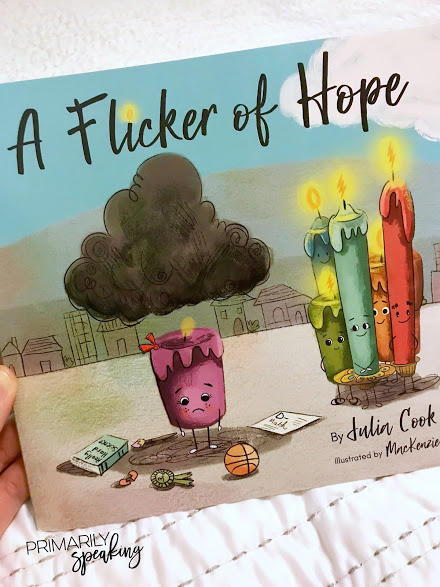
There are two kinds of books that I am constantly seeking out. They include books about individuality and books that help teach resilience and perseverance. So, when the National Center for Youth Issues reached out and asked if I would like to review A Flicker of Hope by Julia Cook, I jumped at the chance.

Teaching Students to Ask for Help

I received this book for free to provide an honest review. All opinions expressed within this post are genuinely my own and impartial.

This post contains affiliate links for your shopping convenience. I earn a small commission each time someone makes a purchase through one of my links. For more information about my Disclosure Policy, please visit this link.

What's it about?
A Flicker of Hope is Julia Cook's newest book. If you aren't familiar with Julia's work, do yourself a favor and get familiar with it. Her books are perfect for addressing a myriad of issues relating to kids' well-being and development.

A Flicker of Hope is about a little candle whose flame isn't burning as bright as it once was. She constantly finds herself beneath a canopy of black clouds, which is dulling her flame. Little candle feels like giving up. This all changes when another candle approaches her and offers her words of encouragement, or hope. Little candle is reminded that she is important, that she has a special role to play in this world, and that she matters. She's also reminded that she isn't the only one who feels bogged down by troubles and that it's alright to ask for help. As her new friend gives her hope, little candle's flame begins to grow brighter, and eventually, she is able to share hope with others.

Why is this message important?
Having hope is a part of life. In fact, it's a necessary part of life. Without hope we have don't have perseverance, determination, or a sense of accomplishment. Our world is filled with high expectations, unkind people, naysayers, and other pressures. Hope helps us to overcome these adversities. Having hope can take us from a place of darkness to a place of light. It can free us and empower us to believe that better days are ahead.

Sometimes, as a part of having hope and coping with the challenges of everyday life, we have to ask for help. While this may seem basic and obvious to many, the reality is, many kids struggle with this. Seeking help is interpreted as being weak or lacking knowledge. Or, it's downright scary. Kids need to know that reaching out to others is an important life skill. One that will benefit them more than they could ever imagine.

Fostering the psychological and emotional development in children is important. If you haven't heard of the The National Center for Youth Issues, be sure to visit their site. They create resources that address the developmental needs noted above. They also provide adults with effective tools to help kids as they develop in these areas. What they do is important.  Please visit their website to learn more.

How will this book benefit me?
Picture books are a classroom teacher's most powerful tool. Kids love to be read to. Even the bigger kids (this book is perfect for this age group). This book offers a means to facilitate important conversations about asking for help, valuing your strengths, and helping others to do the same.

How can I use the book?
  • Read it to your class and lead them in a discussion about having hope and asking others for help. You might create an anchor chart with them. Brainstorm a list of people they can turn to and how those people can help.
  • Turn the book into an interactive read aloud. Meaning, you read the book and in doing so, engage your students in meaningful discussion about the text by asking questions. Be sure to plan this out ahead of time to maximize the effectiveness of your read aloud.
  • After reading the book, have your students complete a reading response journal entry. They could write about a time when they reached out to someone for help, or a time they helped someone find hope. Or, they could write about why they think having hope is important.
  • After reading the book, discuss the points noted on the organizer pictured below. Then, have students complete the organizer. Use this organizer to help students identify what hope is and what they can do to when they need hope.
Teaching students to ask for help freebie

You can grab this free organizer by clicking here.

Click here to see this book on Amazon.

Teaching students to ask for help

This book is a wonderful tool to have on hand. Sometimes it can be difficult to have conversations about psychological and emotional needs when your expertise is in differentiating math, or creating engaging reading lessons. However, more and more, our students need us to be able to address these needs, and a book like A Flicker of Hope, is a great way to help you facilitate this process. For more wonderful Julia Cook books, click here.

DON'T FORGET IT, PIN IT!


Teaching students to ask for help


Share It:

The Jelly Donut Difference {Teaching Kindness}

The topic of kindness is a recurring topic of conversation in my classroom.  Our school promotes kindness every day, and several times a year, I look for opportunities to specifically address this social skill.  One of my favorite ways to talk about important skills that relate to character is with the help of a picture book.

This post contains affiliate links for your shopping convenience.  I earn a small commission each time someone makes a purchase through one of my links.  For more information about my Disclosure Policy, please visit this link.

I recently shared The Jelly Donut Difference by Maria Dismondy with my students and it was a great way to review this concept.  Keep reading for a few ideas and links to free resources!


If your aren't familiar with Maria Dismondy then keep reading and then head on over to Amazon and grab as many of her books as you can. They are a must when it comes to your stash of picture books!

About the Author
Maria has a background in early education, so she knows kids.  She write books with strong moral messages and diverse characters.  Her characters are likeable and students can relate to them.  That's why her books are so great for teaching things like kindness, empathy, and understanding.  Her hope is that kids will remember how the characters in her stories handled difficult situations should they ever find themselves in a similar position.  And chances are, at some point they may.


The Book
The Jelly Donut Difference is a great book to share with your students.  It has amazing illustrations.  And, the story is one that students can relate to.

Dex and Leah are twins who live next door to an older woman who lives alone.  When they learn more about this woman who lives alone, they decide that they want to do nice things for her so that she feels happy and not so lonely.  I'm not going to share all the specifics because you really need to read this book for yourself.  ;) 

In the Classroom
Like any picture book, you can use this story to review story elements, analyze the characters, and the like, but my favorite way to use these sorts of books is to have my students make connections to the text. I like to use it as a means to promote reflection and understanding of the citizenship skills covered in the story.  This story, in particular, drives home the important message of generosity and kindness and I made that the focal point of our follow up activities.

After reading the book, we talked about the author's purpose.  More specifically, we talked about what exactly it was that the author wanted the reader to learn from the story.  Lately, we've been working to more specific when identifying the author's purpose.   

Then, we talked about some important words.  These words aren't used in the text, but they are all represented in the text. I thought that these words would be appropriate to discuss and then connect to the text:
  • thoughtful
  • kindness
  • empathy
  • compassion
  • generosity
It isn't necessary to use all of these words, of course. I didn't.  I chose the ones that I felt my students would be most likely to understand and relate to the text.  You can grab the anchor chart pieces HERE (the download includes all the words listed above).

As you can see, I put the definition of each word on the anchor chart.  Then, as a group we thought of examples in the text where these qualities were seen in action with the characters.


I left the chart up because I wanted my students to be reminded of these important qualities and because I wanted them to choose one to focus on.  I often task my students with setting kindness goals at school, but this allowed them to try and engage in other forms of selfless action.

I also had my students write a letter to the author.  We are currently in the midst of a letter writing unit, so it seemed perfect!  In the body of their letters, they wrote about what they liked about the story, as well as what they learned from it.  From there, they were free to write whatever else they wanted including asking the author a question or two.  I enjoyed reading their responses and seeing where it led their thoughts. You can grab this letter writing template HERE.  :)


If you're looking to add a meaningful picture book to your collection of resources, be sure to check out The Jelly Donut Difference.  It's sure to be a book you go to year after year.

Happy reading!

DON'T FORGET IT, PIN IT!


I received this product for free to provide an honest review.  All opinions expressed within this post are genuine and impartial.


Share It:

My Favorite Gingerbread Books

I am a sucker for The Gingerbread Man.  Really, I am.  I love this story and all the different versions out there.  Not only is it a fun story, but it is perfect for working on things like retelling, comparing and contrasting, character analysis, and more!

December is my favorite time to share this favorite with my students.  Of course, I have several favorite versions on this story.  I tend to vary the ones I use from year to year, but I love having options. 
Gingerbread Books for the Primary Classroom
This post contains affiliate links for your shopping convenience.  I earn a small commission each time someone makes a purchase through one of my links.  For more information about my Disclosure Policy, please visit this link.

Let's start with the traditional versions of the story.  I love these three. When kicking off my Gingerbread Man unit, I always read one of these first.


The Gingerbread Man (yellow cover)
The Gingerbread Boy
The Gingerbread Man (brown cover)

Each of these is a fairly standard version of the story.  I like to use these traditional versions to practice our retelling skills.  Focusing on the book in this manner helps the students to really think about the story, which prepares them to do some compare and contrast when we read different versions like the ones shown below.


The Gingerbread Girl
In this version, the starring role goes to a gingerbread girl.  She is quick and sassy, just like her brother who was eaten before her. She gets chased by several different characters, but she gets away from every single one of them.  As the story progresses, we learn that she is much smarter than her brother because she is able to outsmart that tricky fox!

The Gingerbread Bear
I seriously love this story.  The cookie in this story is a bear who makes his way through Woodlands National Park. The bear is quick and gets away from several characters including some campers, a squirrel, and a wolf who chase after him, but eventually, he goes up against a park ranger....and loses.

The Ninjabread Man
In this story, a sensei bakes a special ninjabread treat (a gingerbread ninja).  The Ninjabread Man comes to life and tells the sensei that it is time that his students put their skills to the test by trying to catch him.  Then, he runs away.  After sensei signals the gong, his students approach the Ninjabread Man one by one.  The little cookie escapes every time, until (you've probably guessed it), he meets the fox, who outsmarts him.   The book also includes a small glossary and a recipe for ninjabread cookies.

The Gingerbread Pirates
This story is so fun, but also completely different than the traditional story.  You won't find any chases in this book.  A boy and his mom make a crew of gingerbread pirates.  The gingerbread pirate captain (with a toothpick peg leg) goes in search of his pirate crew to rescue them from the scary "cannibal" known as Santa Claus who is known for eating cookies just like them.When they meet Santa, he swears he won't eat them. It's full of fun and adventure.

It's also fun to read a few multicultural versions of the story too!

Multicultural Gingerbread Man Books

The Matzo Ball Boy
This story is a spin off of the traditional gingerbread man story. It is a rather long story, but it's filled with humor.  It includes various Yiddish words, but there is a glossary (and pronunciation guide) in the back of the book to help you explain them to your students.

The Sourdough Man
In this story, a loaf of Alaskan sourdough comes to life.  He is quick and runs away from various animals of the tundra. He encounters a musk ox, a lemming, a hare, a caribou, and more.  None of these animals is a match for the Sourdough Man. Well, until he meets the arctic fox, anyway.  The back of the book gives a bit of history about Alaska's sourdough past and also includes directions for making your own sourdough starter.

I recently added this one to my collection, and I can't wait to share it with my students.

Multicultural Gingerbread Man Books

Senorita Gordita
Senorita Gordita is a little runaway corn cake.  She is "zip-zoom-fast" as she runs through the desert. She encounters different desert animals including (but not limited to) a snake, a scorpion, and a lizard, but she gets away from all of them. Sadly, she eventually meets an owl who outsmarts her and gobbles her up.  There are several words in Spanish including the characters' names, but each term is defined in the back of the book.  You can also find a recipe for gorditas in the back of the book.  Yum!

Any version of this story makes it super easy to work on important reading skills such as retelling, comparing and contrasting, and analyzing characters.  It's also easy to incorporate some writing by having students pick a favorite version and explain their reasoning. They could even write their own version of the story, or have them get creative and write about how to catch a gingerbread man. Sometimes, they come up with some pretty clever ideas!

Gingerbread Man Writing Freebie

Want to see how your students would catch a gingerbread man?  Then be sure to grab the free templates shown above by clicking HERE.

Looking for other gingerbread man resources?  Then, be sure to check out my Gingerbread Man unit on TPT.  It was created for use with any version of the story and covers a variety of skills like the ones shown below.  Not only is it educational, but it's fun and engaging. You can check out the complete unit HERE.

Gingerbread Adjectives


DON'T FORGET IT, PIN IT!

Gingerbread Man Picture Book Read Aloud Ideas


Share It: