Showing posts with label Teaching Ideas. Show all posts

Using Stuffed Animals in the Classroom

Kids love stuffed animals. I mean, they LOVE them. They are comforting, cute, and make the students happy. Here are three ways you can use them in your classroom.
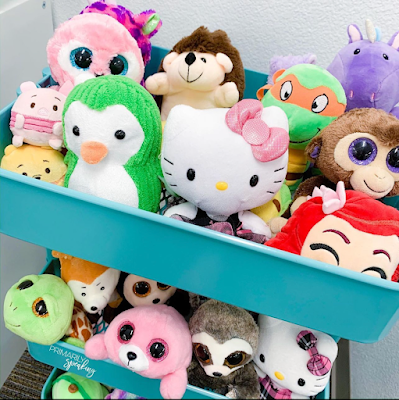
reading buddies

Reading Buddies

This is my favorite way to use stuffed animals in the classroom. You're probably thinking that reading buddies are supposed to be human. You know, you pair a class of younger students up with a class of older students and every week/every other week they read together. But, did you know that stuffed animals can also serve as reading buddies? 

My second graders have fifth grade reading buddies, but they don't meet up with them every day to read. But, they do have their stuffed animal reading buddies that they can read with every single day (even when their fifth grade buddies visit). 

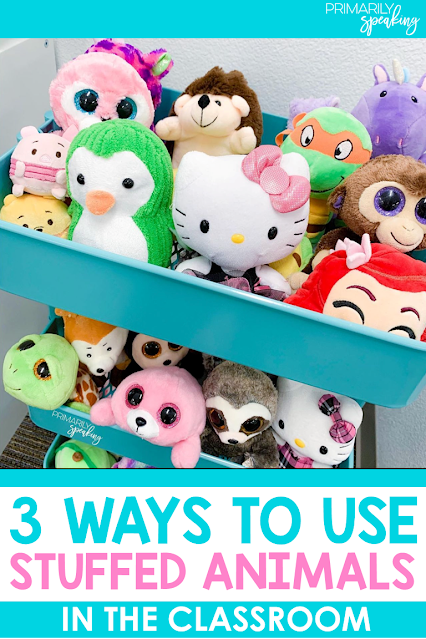
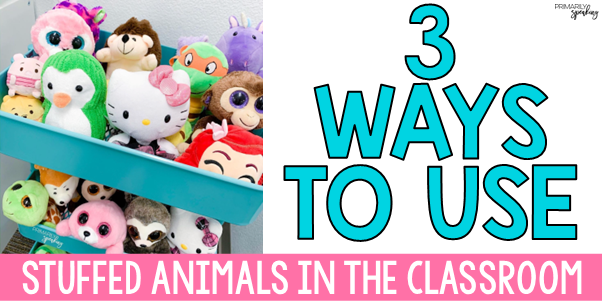
Keep your stuffed animals in a spot with easy access, like a cart shown below. When it's time for students to silent read/independently read let them choose a reading buddy to read to.  

reading buddies

Here are a few expectations you might want to consider:
  • Use one reading buddy at a time.
  • Read to your stuffed buddy or cuddle it as you read.
  • Do not play with your reading buddy or you will have to put it back.
  • Treat the reading buddy with care (we want them to last).
  • No arguing over who gets which reading buddy, they all need love and cuddles.
In my classroom, if a student decides to play with their reading buddy when they should be reading, they have to put it back, but just for that day. The next day, they are welcome to try again.

Students love reading to the stuffed animals. Honestly most of them usually just cuddle it as they read. I think it's comforting and sometimes, you just need to feel comforted/comfortable. 

Recognizing Students Throughout the Day

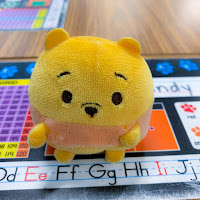
When you see a student making good choices, place a small stuffed animal on their desk. It can stay there all day or it can move from desk to desk throughout the day. I started doing this with my class last year and they loved having mini Pooh and Piglet visit them while they worked. Sometimes, they stayed on a desk for quite some time. Sometimes, they hopped from desk to desk. The students loved having them pop in for a visit and it was a great way to motivate them to make good choices.

stuffed animals in the classroom


Practice

Speaking in front of the class is nerve-wracking for some students, but we do have speaking standards to assess. Students can use the stuffed animals to practice reading their writing aloud, or practice whatever it is that they are tasked with sharing aloud. You could even allow students to bring a stuffed animal with them as they present if they are especially nervous about it.

A Few Tips

Acquiring Stuffed Animals

Most of my stuffed animals came from my daughter's over the top collection. I purchased a few here and there, but I never spent much on them. If you are looking to purchase your stuffed animals, check out Kohl's or Oriental Trading. They usually have lots of affordable options.

Small vs. Large Stuffed Animals

The smaller the animals are, the more you can store. Most of my stuffed animals are Beanie Boos, which are on the smaller side, so I can offer my students a lot of choices. I also have more than enough for each student to use one. There's nothing wrong with larger stuffed animals, just remember they will take up more space and you might not be able to house a class set if that is your goal.

Taking Care of the Stuffed Animals

Wash your stuffed animals, please! Preferably more than once a year. The frequency with which you do so is up to you and your preferences, but keeping them clean is a good idea. I simply throw mine into the washing machine and give them a good spin. After that, I let them air dry.

Stuffed animals are a great way to bring some fun and joy into the classroom. They can be used in so many ways too. 

DON'T FORGET IT, PINT IT!

Stuffed animals in the classroom


Share It:

Lucky Duck {A Classroom Community Routine}

Teachers spend a great deal of time building classroom community at the beginning of the school year, but really, this is something that should go on throughout the year. I'm so excited to share with you a tried and true favorite community building activity of mine: Lucky Duck.


I have used this routine in my classroom for many, many years. It dates all the way back to my student teaching days (almost two decades ago).

I'm going to break down how "Lucky Duck" works in my room, but please know that it can be modified and used in a million different ways. So, feel free to tweak and customize these ideas to meet your needs and teaching style.

What is Lucky Duck?
Lucky Duck is basically the student of the day. Each day a new student gets to identify as the Lucky Duck. When you're 7, it's a pretty big deal.

How does it work?
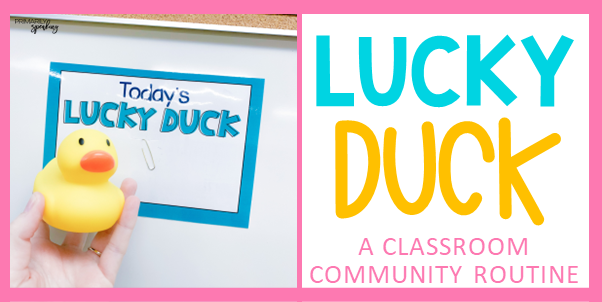
Each day, after school, I select a new Lucky Duck. I have a small tray with my students' names printed on them. I rotate through the stack of names and place the daily name up on the board using the sign pictured below. Doing this right after school means that it's all set up for the morning (when there are always a million and one distractions).


These are the names in their little container. You can easily cut up index cards or cardstock to write students' names. You can grab my sign here for FREE (you'll need to handwrite your students' names). Rotating through the stack of names means that each student gets the chance to be Lucky Duck several times throughout the school year. 


Tip: Don't want to mess with a sign and name cards? Then, just write it all on your whiteboard. Same effect and the kids will still love it!

Once I identify the Lucky Duck, I place a rubber ducky on the student's desk. When the kids walk into the room in the morning, they can see who the Lucky Duck is by either reading the board or looking for the rubber duck.


What does the Lucky Duck get to do?
What I'm about to share is what makes this such a big deal to my students.

Daily News
First, they get to share some Daily News. Usually, I ask the students a question and they have to answer by restating the question. You can grab a similar set of questions here (freebie).


I write their statement on a piece of 12x18 construction paper using the this format: ______ said, "_________." I don't rely on the question cards 100% of the time. I often times invite the students share any random thought they'd like. This love this.


Daily News is so great for learning how to write the date (long and short) and how quotation marks work. It's also great for talking about parts of speech, capitalization, phonics, or whatever your teacher heart is drawn to in the moment. I frequently ask students to identify compound words, words with a specific number of syllables, words that rhyme with ___, to identify nouns or verbs or adjectives, we discuss capitalization and commas in a series, and so on.

Daily Cheer
Second, the Lucky Duck gets to pick the cheer of the day. I have a collection of Dr. Jean chant/cheer cards. They choose one from the designated box and we use it throughout the day. Sorry, no pic but if you search Dr. Jean chants on TPT you can find some great freebies!

Calendar
Third, they help lead calendar. Again, no pic. I really have got to get better about snapping pics in my room! Anyhoo, we use a digital calendar which can be manipulated using a special pen for the whiteboard (I do not have a smartboard, it's just some pen that connects to my projector/computer and has some sort of magical powers I do not fully understand). 

The Lucky Duck leads us through the calendar slides and calls on people to share answers. They also get to prompt them to show their whiteboards. In my classroom, we use the signal, "3-2-1 show!" when using whiteboards. I never thought that being able to say those words would be such a hit, but they are. Haha!

Daily News Part 2
Fourth, the Lucky Duck gets to decorate/illustrate their Daily News. They can do so in their free time, or during reading group time that day (if their group isn't meeting with me).


At the end of the month, I put all the Daily News pages together into a special book and add the books to our classroom library. They absolutely love reading the Daily News books over and over again. They enjoy seeing their own pages, and delight in reading about their classmates. This allows them to learn more about each other and find commonalities.

As you can see, the book doesn't look special, but I'm telling you, they are always the most popular books in the classroom library. The cover is simply two pieces of colored 12x18 construction paper with the simple title written in Sharpie. I have started laminating the covers due to the popularity of the books.


Line Leader
Finally, the Lucky Duck gets to be the line leader for the day. Enough said, we all know that's like the BEST classroom job/privilege in the whole wide world.

This routine is a beloved one. The students absolutely love being Lucky Duck. They all get their moment to shine (several times throughout the year), and they get to know more about one another through Daily News. When we sit on the carpet to hear what the Lucky Duck has to report, the students are at full attention. It's an easy way to help students feel special while fostering community in the classroom.

The only cost involved with this routine is the one time cost of a rubber duck. Mine cost like $3 on Amazon. Can't beat that!

I hope you enjoyed reading about this special routine. Please share your favorite ways to build community throughout the school year in the comments below.

DON'T FORGET IT, PIN IT!


Share It:

10 Reading Week Ideas

Once a year we get the opportunity to dedicate a full week to all things related to reading. Reading Week, or Read Across America, is such a great way to instill a love of learning in students.


This post contains affiliate links for your shopping convenience. I earn a small commission each time someone makes a purchase through one of my links. For more information about my Disclosure Policy, please visit this link.

My school does a lot of school wide events to make Reading Week special, but I always like to do a few things of my own. If you're looking for some simple ways to make this week extra special for your students, then keep on reading.

Book Snack
During a read aloud, let your students enjoy a special snack. This can be as cutesy and themed as you want it to be (or not at all). Trust me when I tell you that your kids will love snacking on Goldfish as you read Mercy Watson to them. But, if you want to amp it up a bit, here are a few suggestions to work with:

Random Themed D.E.A.R. Times
Rather than offer silent reading at the same time each day during Reading Week, switch up the times each day. Better yet, make that D.E.A.R. (Drop Everything and Read) time themed! This is such a simple way to make silent reading more fun. Invite your students to participate in daily themes such as reading to a stuffed animal, laying on a pillow, or reading in the dark with a flashlight. Send home the note below home the Friday before Reading Week so students can prepare over the weekend for day one.


You can grab this D.E.A.R. note by clicking HERE. :)

Schedule some D.E.A.R time for Read Alouds
D.E.A.R. time isn't just for silent reading. It can be for read alouds too! So, drop everything and read to your students. They'll love it.

Flashlight Read
If you don't like the idea of themed D.E.A.R. time, then opt for a day or two of flashlight reading. Finger flashlights are always popular with students. Turn down the lights, give each student a finger flashlight, and let them read. Easy peasy.


Find a New Place to Read
Weather permitting, maybe you can take your kids outside to read one day. Is there anything more fun than sitting on the play structure and reading?

If the weather isn't cooperating, then find other places in your building to read. Maybe you could let them read:
  • on the school stage
  • in the hallway
  • in your computer lab
  • in your school library (if it's available for use)

Buddy Read
Partner up with a different grade level for some buddy reading. I remember having Big Buddies in elementary school (and then one day becoming a Big Buddy myself). It was always so fun to read with kids in a different grade.

Have a Read-In
Let your students participate in a read-in. This could be a full day event, or a half day. Let students bring a blanket and pillow so they can cozy up as they read. And, if you're feeling bold, let them build reading forts.

Set Out Baskets of Special Books
Put out some special baskets filled with books. These books can come from your own classroom library, or even the school library. Choose some fun themes, new titles, or Caldecott winners and invite your students to read these featured books during D.E.A.R. time.

Book Share
Throughout the week, let the students take turns sharing a favorite book. This is an easy way to incorporate some speaking and listening into your week. Once students choose a book, they can explain why they like it. It would also be a great way to get students excited about reading new books.

Make a Bookmark
Let your students make a bookmark. They could make one from scratch (give them a plain white template and let them have at it), or let them color a bookmark like the one shown below. You can grab this fun bookmark by clicking HERE. :)


Extra, Extra
A few fun extras you might want to consider are sending home Reading Bingo to encourage more reading at home. Or, a fun reading themed graphing activity that allows you to get in a little extra math practice. You can grab both of these fun extras by clicking HERE. :)


I hope you are able to use an idea or two from this post! Happy reading, my friends. And, don't forget, you can grab all of the fun resources featured in this post for FREE by clicking HERE.

DON'T FORGET IT, PIN IT!


Share It:

9 Meaningful Time Fillers for the Primary Classroom

I know it can be rare to find yourself with a few extra minutes in the school day, but it does happen. And, when it does, it's definitely a good idea to have a variety of time fillers to quickly choose from.

Time Filler Ideas Primary Classroom Management
This post contains affiliate links for your shopping convenience. I earn a small commission each time someone makes a purchase through one of my links, which allows me to buy more books for my classroom. :) For more information about my Disclosure Policy, please visit this link.

Time fillers can give you the opportunity to add a bit of whole group fun to your day. They allow you to provide engagement in a different capacity. And, they can be used to foster community and/or quickly reinforce a variety of important skills.

I've decided to compile a list of my all time favorite time fillers that I rely on throughout the year. With each filler, I've identified about how much time it will fill. In many cases, the filler can be used for as long as you'd like, but can also be used when you only have a few minutes. And, I'm sharing them in no particular order, so be sure to work your way down the list. :)

Brain Quest
I just love, love, love Brain Quest. If you aren't familiar with Brain Quest, it's basically a question and answer game. Each set is packed with content related questions, as well as other stuff that kids should (and need to) know. Students are challenged to put their thinking to the test.

Duration: 5-15 minutes


Mad Libs Junior
Mad Libs are so fun! My second grade teacher used to do one with us everyday before lunch. I have many fond memories of our daily Mad Lib time. Every year, I share Mad Libs with my own second graders, and I have yet to meet a group of students who doesn't love them. I can reinforce basic parts of speech, and we all get in a good laugh (laughter is good for the soul). I prefer to use Mad Libs Junior with my students. I know the content is always going to be safe that way. ;)

Duration: 5-10 minutes (depending upon your pacing and/or how many you do)

Mad Libs Junior Sports Star
Mad Libs Junior Under the Sea
Super Silly Mad Libs, Junior
Summer Fun Mad Libs Junior

Whiteboard Review
If your students love using their personal whiteboards, then pull them out when you've got some time to spare. We all know this tool is super versatile, so use it to fill the time and review things that you're currently working on in class.

I often have my students spell words using a new spelling pattern, or solve multi-digit addition and subtraction problems. I also use them to play a quick game of true/false. To do this, I say something like, "There are 24 hours in a day." The students then respond by writing True or False (or "T" for True and "F" for False) on their board.

Duration: 5-10 minutes

Q's Race to the Top (On the Go)
Q's Race to the Top is a Q&A game that is great for discussing topics related to social skills and fostering emotional intelligence. It's actually a set of question and action cards, and not so much a game where you race to the top. There is a board game version of this, but the "on the go" version is just a set of cards (see below). But, they are great for the classroom. There are three different kinds of cards.


The Q cards are scenario cards. They share a scenario that involves Q, the monkey pictured on the lid.  Students then reflect on the scenario and relate it to their own life or experiences.


The You cards also ask a question. These questions lead to opportunities for meaningful discussion.


Then, there are the Do cards. Students follow the directions on the card to perform some kind of action. Quite truthfully, they are not connected to the question cards, but they are a great way to get your students up and moving, if only for a few minutes.


Duration: 5-15 minutes (just depends on how many cards you go through and how much time you have to discuss each card)

Go Noodle
Speaking of moving, Go Noodle is perfect for getting kids up and moving! Students move to song or dance, in most cases. There are so many different options. The goofy Koo Koo Kanagroo guys are always a favorite for jumping around and being silly. And, Maximo is a favorite when it comes to slower paced movements (I like that they require some concentration and focus).

Duration: 1-5 minutes (it just depends on the video you pick)

Read Aloud
Anytime is a good time for a read aloud, if you ask me. Keep a variety of books on hand that give you some flexibility to use a read aloud as a time filler.

The Mercy Watson series is perfect for this! The chapters are super short, and super high interest. Your students will laugh out loud.

Duration: 5-6 minutes per chapter


Read a Poem
Poetry is always another time effective read aloud option, and since kids don't hear them as often, they are usually a captive audience.

Shel Silverstein's Where the Sidewalk Ends is my favorite. This is another time filler I remember my own second grade teacher using back in the day.  His poems are so silly and fun to share.


For even more excitement, let your students listen to Shel tell his poems. It is always entertaining. Sometimes, I pop in the CD shown above (which is no longer available, for a reasonable price, on Amazon). I'm not sure if these recordings are available in other formats or not, but it's worth a quick Google search.

Duration: 2-10 minutes (depending upon which, and how many, poems you read)

I Have, Who Has
Once your students know how to play this game, it can become a great time filler. Plus, your students will practice important skills at the same time!  You can grab this plural noun I Have, Who Has here (it's free!).

Duration: 10-15 minutes


Whiteboard Doodles
I'm all about reinforcing skills and sharing literature whenever I can, but sometimes, you and your students need a short break from each other. Sometimes, students need some time to just unwind.

This is where whiteboard doodling comes in handy.  Let your students take out their personal whiteboards and doodle away. Let them draw or write whatever they want on those boards. They don't always get to use their boards for fun, so when they do, they are happy campers. Let them get lost in their own creations for a few minutes. It will keep them on task, allow them to empty their mind of any ideas floating around in there, and to refresh their brain for the next lesson.

Duration: 5-15 minutes

Do you have a favorite time filler?  Comment below and tell us your favorite way to fill the time. :)

DON'T FORGET IT, PIN IT!

Time Filler Ideas Primary Classroom Management


Share It:

Using Exit Tickets to Support Reflection in the Primary Classroom

Exit tickets are a great informal assessment tool.  Typically students respond to a question at the end of a lesson. The students' responses are helpful in determining the various levels of understanding among the students. They are a quick and easy way to identify and meet your students' needs.

Using exit tickets to assess specific skills is great, but I really like using them to help students develop the skill of reflective thinking.

exit tickets freebie primary classroom

As teachers, we are encouraged to reflect on our teaching.  We focus on the lessons that we've taught and identify what went well, what didn't go well, and how we can improve the things that didn't go well.  This kind of thinking is important for our students too.  Students of all ages should be encouraged to reflect on their learning experiences whether that entails identifying what they learned or how they felt about that learning.

Chances are you already do this in one way or another. Exit tickets are by no means the only way to help students be more reflective of their learning, but they are a quick and easy way to do this.

Using Exit Tickets for Reflection
We definitely need to know how our students are specifically performing on various skills, but it's also important that we encourage them to think about their learning and to reflect upon it in different ways.

Here are a few benefits of using exit tickets to encourage reflective thinking:
  • They give students practice with higher order thinking and self-monitoring.
  • They help students think more deeply about their learning experiences.
  • They are an easy way to squeeze in a bit of extra writing.
  • They give students practice with communicating thoughts and ideas.
  • They can provide insight to your students' strengths and weaknesses from their perspective which can help drive your instruction/interactions with your students.
When starting out, keep it really simple. Maybe you begin by having your students simply identify how a particular lesson went for them, without writing anything.


Once they become comfortable with reflecting on their learning in this capacity, use exit tickets that require them to write about their learning. 


When is the right time to use reflection exit tickets?
At the end of a lesson, of course!  But, who's to say you couldn't also use them at the end of the school day?  I say do it!

Once your students have mastered the skill of reflecting on a single lesson, transitioning to the task of reflecting on a longer chunk of time makes sense. More specifically, why not task students with reflecting on their whole day?  They can focus on one or two learning experiences (depending upon the exit ticket you use). 


When students are tasked with reflecting on a longer chunk of time, like the whole day, they practice prioritizing and weighing options as they choose what to share on their exit ticket. It might be challenging, at first.  And, that's OK.  Challenge + Practice (and persistence) = Growth.

The more opportunities students have to reflect on an entire day's learning, the easier it will get for them.

Frequency
Honestly, how often you use exit tickets for reflection is entirely up to you.  I don't like to overdo it because then students are less likely to submit quality responses. They are also less likely to take the act of reflection seriously.  I think 2-3 a week for my second graders is sufficient for working on this skill. 


What should I do with the exit tickets?
What you do with the exit tickets is entirely a personal preference, but here are a few suggestions:
  • Glue or staple them to appropriate pages in interactive notebooks.
  • Write a note to students on the exit ticket and send them home.
  • Hang on to the exit tickets and staple them to completed assignments when/if appropriate.
  • Keep them long enough to help you decide whether you need to address certain issues or reteach any content.
(Free) Resources
If you're looking for a few exit tickets you can use to encourage the skill of reflection I've got you covered.  Click HERE to download all of the exit tickets shown below.  You can use them at the end of a lesson or at the end of your day.  Enjoy!

exit tickets freebie

DON'T FORGET IT, PIN IT!

exit ticket freebie


Share It:

So Many Task Cards, So Many MORE Uses {7 MORE Ways to Use Task Cards in the Classroom}

Task cards are a staple that every teacher can use.  They are effective and engaging, low prep, easy to use, versatile, and they can be used with any subject.  Task cards are one of my favorite resources because of all these things.

How to Use Task Cards


A while back, I shared ways in which task cards can be used in the classroom.  Click HERE to read my original post featuring seven terrific uses for task cards.

But here's the thing, there are even more ways to use task cards!  So, I'm back with a new post featuring seven more ways to use this versatile resource.


Use them to assess your students at the end of your lesson.
In my previous post, I shared that I often project task cards (one at a time) via my document camera as part of our math warm up.  Why not project them at the end of your lesson (any subject) to assess your students' understanding of the content you just taught?   

To do so, have your students respond on their personal whiteboards. Don't have personal whiteboards?  Place a piece of paper in a dry erase pouch (see below), it can serve the same purpose.  :) They can hold up their answers on your signal and you can quickly assess.  From there, you can note who you need to meet with in small groups for further instruction or address any misconceptions on the spot.


Use them to give students practice with explaining their mathematical thinking.
Yes, there are task cards for every subject, but I love using my math task cards to help students practice and gain confidence in the area of explaining their mathematical thinking.

Give each student a task card.  Then, pair students up and task them with explaining to their partner how they solved the problem/arrived at their answer.  This is a difficult skill for primary students (at first) and by practicing with a classmate one on one, it can ease their nerves and help them build confidence. 


Use them to play a game of Around the School.
Around the Room (or I Spy as I often call it) is huge deal in my classroom.  We play it often, and the kids love it. You can use any set of task cards for this activity.  Simply set your task cards around the room, give your students a clipboard, and have them go from card to card until they are finished. You can read more about his activity here.

Buuuut, if you want to mix things up, or reward your students (while sticking to your objectives) why not take that game of Around the Room (or I Spy) out into the hallways and learning areas around your school?  Or, even the playground?  Of course some ground rules would be in order, but it would be a fun change of pace.


Use them as an exit ticket.
Yes, this is another form of informal assessment, but it's good to have variety!  Task cards are usually printed 4 to a page.  Print out a page of cards and have your students solve/answer the four cards on their page as their exit out the door.


Use them at the end of your lesson for independent practice.
I like to do this often.  At the end of my lesson, I will divide a set of task cards up among my table groups.  And, I give each student a piece of paper (sometimes colored paper...because that's more fun) and have them fold it into sections (usually four).  They use the spaces on their paper to solve any four of the task cards at their table group.

So, how is this different than an exit ticket?  Because, once the students have solved/answered their task cards, you can invite volunteers to come to the whiteboard to teach the class!  They can show their task card to the class and then show/explain how they answered it.  This can be done using a dry erase marker, or they can place their paper under the document camera.   Or, pair students up and let them teach each other (kind of an extension of idea number two).  Simply choose a method of sharing that best matches the type of task cards your students are working with.

For me, this works best with math task cards because the students show their work. They can bring their task card and their paper to the board and show the class how they solved the problem.  Then, when I go back to their papers later on, I can easily understand and evaluate their work.


Use them to play Race to 10.
Students can work in pairs to play this game. Give each pair of students some task cards (at least 24) and some counters.  Students place the set of task cards face down between them.  To play, students take turns solving/answering each task card.  Each time they get the answer right, they collect a counter.  The first person to collect 10 counters is the winner!


Use them to play a game.
Pair students up and have them use their task cards to facilitate a game of tic-tac-toe!  Give each pair of students a stack of task cards.  They can draw a game board on a piece of paper and place their stack of task cards (face down) next to their game board.   Students will take turns answering the question on their task card. If they answer correctly, they get to mark a space on their tic-tac-toe board.  If they do not answer correctly, they skip a turn.  Using double sided counters is a great way to preserve the game board.  When the game is over, they can be easily cleared away so that a new game can be played without having to redraw the game board.  :) 


You could use this same idea with any game, like Candy Land, Chutes and Ladders, and so forth.

Be sure to visit THIS POST for more ideas for using task cards in the classroom.

Looking to add some task cards to your classroom?  I have several sets of math related task cards in my TPT store.

https://www.teacherspayteachers.com/Store/Primarily-Speaking-By-Aimee-Salazar/Category/Task-Cards-174571

I hope you were able to take a new idea or two away from this post!

DON'T FORGET IT, PIN IT!

Ways to use task cards


Share It: